
Last updated: October 2026
Quick answer: 1000 words is about 2 pages single spaced or 4 pages double spaced. That’s based on 12 pt Times New Roman and 1 inch margins, the setup most schools and offices use. Change the font, spacing or margins, and the page count shifts with it.
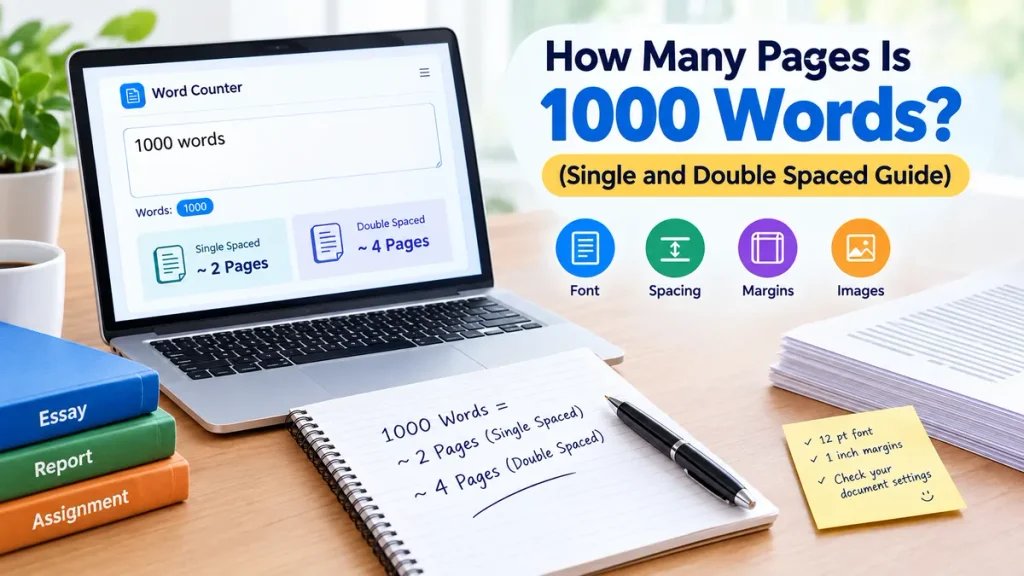
Your assignment, report, or set of instructions for a client specifies “1,000 words,” and you would like to get an idea of what that looks like on the page. Perhaps you have a length requirement to meet, or maybe you are concerned that you might be writing too little—or too much.
You already have the short answer above. The more detailed answer is that pages do not constitute a fixed unit. Two people can write the same 1,000 words and end up with a different number of pages. Let’s look at why this happens and how you can determine a reliable figure for your own document.
Why the Page Count Changes
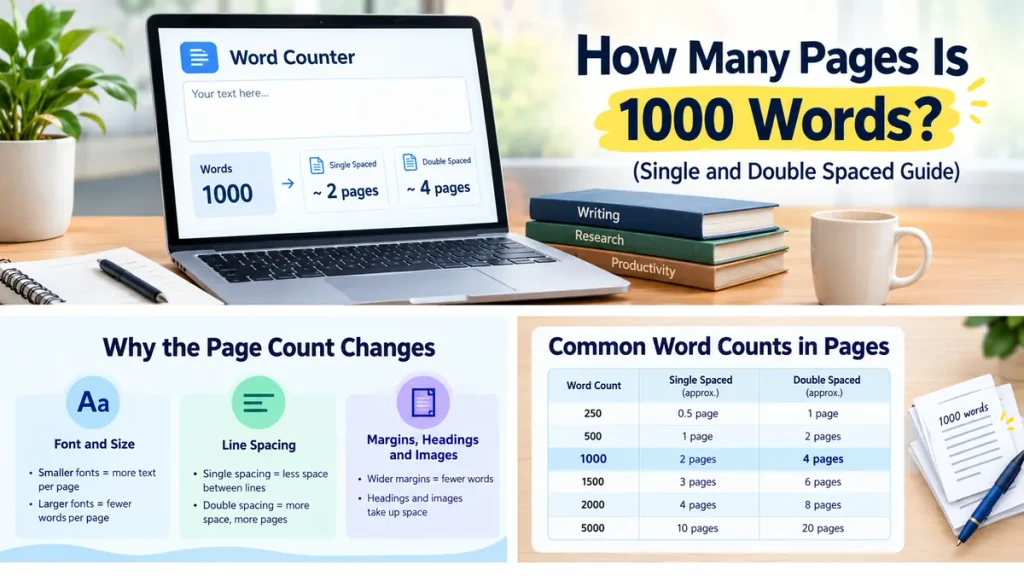
The number of words is fixed, but a page is not. A page is simply the space your text occupies; therefore, anything that modifies that space alters the pages.
Font and size
Some typefaces are wider than others. Times New Roman is narrow, allowing for more words per line, whereas Arial and Verdana are wider and accommodate fewer. Font size is even more significant: increasing it from 12 pt to 14 pt can add an entire page to a 1,000-word document.
Line spacing
Single spacing places lines very close together. Double spacing leaves a space equivalent to a blank line between them. This alone practically doubles the page count; for this reason, academic papers are typically submitted with double spacing.
Margins, headings and images
Standard margins are 1 inch (2.54 cm) on each side. Wider margins reduce the text area, causing the content to span more pages. Headings, bulleted lists, tables, and images also take up space while adding very few words; consequently, a 1,000-word article that includes six images will be longer than a text of the same length that lacks these additional elements.
1000 Words in Pages
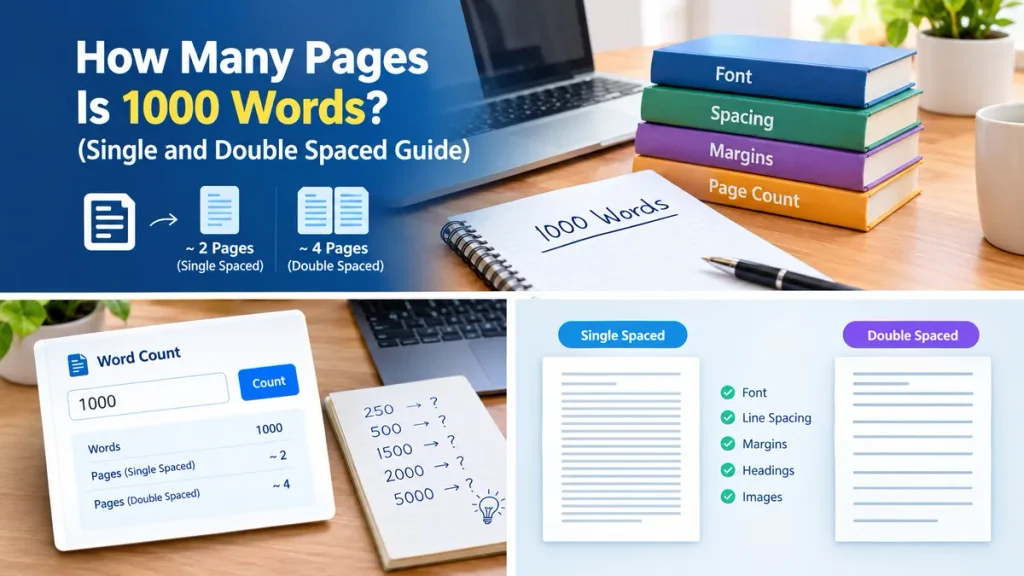
Here’s the standard setup: 12 pt Times New Roman, 1 inch margins, no images.
| Spacing | Approximate pages for 1000 words |
| Single spaced | about 2 pages |
| 1.5 spaced | about 3 pages |
| Double spaced | about 4 pages |
A handy rule of thumb: a single-spaced page holds about 500 words, and a double-spaced page holds about 250.
Fonts shift this a little. As a general guide, a wider font such as Arial or Verdana gives you slightly fewer words per page than Times New Roman, while a compact font gives you slightly more. If an exact page count matters, check it in your own file rather than trusting any chart, this one included.
Other Common Word Counts in Pages
These figures use the same standard setup (12 pt Times New Roman, 1 inch margins):
| Words | Single spaced | Double spaced |
| 250 | 0.5 page | 1 page |
| 500 | 1 page | 2 pages |
| 1000 | 2 pages | 4 pages |
| 1500 | 3 pages | 6 pages |
| 2000 | 4 pages | 8 pages |
| 2500 | 5 pages | 10 pages |
| 5000 | 10 pages | 20 pages |
To go the other way, multiply pages by 500 for single spaced or by 250 for double spaced. A 5-page double-spaced paper, for example, is roughly 1,250 words.
How to Check the Page Count of Your Own Text
Charts give you an estimate. Your own document gives you the truth.
Count your words first
Paste your text into our free Word Counter to see the exact word count. This helps while you’re still drafting and haven’t formatted anything yet. Then use the chart above to estimate the pages.
Check pages in Word and Google Docs
In Microsoft Word, the page number sits in the bottom-left corner of the window, next to the word count. In Google Docs, go to Tools and choose Word count, and the dialog shows pages, words and characters together. Set your font, size and spacing first, so the number reflects what you’ll actually submit.
Tips to Reach (or Cut to) a Page Target
If your teacher or client cares about pages, ask up front whether they want a word count or a page count. If it’s pages, the formatting rules matter, so get them in writing.
Please do not try to increase the length of a document by enlarging the font size or widening the margins. Professors notice this, and so do clients. Including a useful example or a brief counterargument is a much better way to add length than manipulating the formatting.
If you’re over, cut in this order: repeated points first, then long introductions, then adverbs and filler phrases like ‘in order to’ (just write ‘to’). If you’re under, add one specific example per section before you add anything else.
What About Books, Magazines and Handwriting?
The 500 and 250 words-per-page rule applies to typed documents. Other formats behave differently, and these are the questions people ask most often.
- Printed novels: roughly 300 words per page, so 1000 words comes to about 3 to 4 pages.
- Magazines: more words fit on each page, so 1000 words is often 2 to 3 pages, though photos can push that higher.
- Children’s picture books: very few words per page, so 1000 words can stretch across many pages. That is already a long picture book.
- Handwriting on ruled paper: usually 3 to 5 pages, depending on how big your handwriting is and how wide the lines are.
These are rough guides. Page size, margins, line height and the amount of white space all decide the real result.
MLA, APA and Other Styles
Both MLA and APA standards require double spacing, a legible 12-point font, and one-inch margins; consequently, a 1,000-word text amounts to approximately 4 pages in either style. The title page, header, and list of references may add to the page count, but they are generally not included in the total word count. If your instructor specifies “4 pages,” ask whether the references are included in that length.
When Your Teacher Asks for Pages, Not Words
Some assignments are defined by their page count. To plan your work, convert the page requirement into a word count: one double-spaced page is roughly equivalent to 250–300 words; therefore, 4 pages amount to about 1,000–1,200 words. Aim for a figure somewhere in the middle of that range, and then check the actual number of pages in your file.
Two cases where the number is stricter than it looks:
- College application essays often use a word limit, not pages. The Common App main essay, for example, is capped at 650 words. Always follow the application’s own rule.
- Journal and conference submissions may count pages including figures and tables, which can eat up a big share of the limit.
Three Quick Examples
A student with a ‘4 pages double spaced’ task. That means about 1000 words. A safe plan is to write 950 to 1050 words, then check the page count and adjust the last paragraph.
A blogger writing a 1000-word article. Printed on paper it would be about 2 pages, but readers see it on a phone, where it scrolls much longer. Shorter paragraphs and clear headings help here more than the page count does.
A freelancer quoting a client. If the client wants ‘about 3 pages’, ask whether that’s single or double spaced. It could mean 750 words or 1500. One quick question saves a lot of rework.
Common Mistakes
- Using a chart for a non-standard layout. If you use 11 pt Calibri with extra spacing, the chart no longer applies. Check your own file.
- Counting words that don’t count. References, headers and footnotes may or may not be included in the limit. Confirm the rule.
- Padding the layout instead of the content. Bigger fonts and wider margins are easy to spot, and some instructors check the settings.
- Forgetting that images and tables take up pages. If your document has them, 1000 words will run longer.
Quick Checklist Before You Submit
- Count the final words with our free Word Counter.
- Confirm whether the limit is words or pages.
- Set font, size, spacing and margins to the required values.
- Check the page count in Word or Docs.
- Make sure references and headings are treated the way your instructor wants.
FAQs
Is 1000 words a lot?
It depends on the task. For a school essay it’s a medium length, about two to four pages. For a blog post it’s a short one. For an email, it’s very long.
How long does it take to write 1000 words?
That varies a lot with the topic and how well you’ve prepared. A practical approach is to sketch a quick outline first, then draft each section in short blocks. Many people find that planning saves more time than typing faster.
How many paragraphs is 1000 words?
With paragraphs of 100 to 150 words, 1000 words comes to about 7 to 10 paragraphs. Online articles use shorter paragraphs, so you may end up with more.
Does 1000 words change in a different language?
Yes. Some languages use longer words or different spacing, so the same content can take more or fewer pages. The method stays the same: count the words, then check the page count in your own file.
How many words fit on one page?
About 500 words single spaced and about 250 words double spaced, using 12 pt Times New Roman with 1 inch margins.
How many pages is 1000 words in Google Docs?
The same as Word: about 2 pages single spaced or 4 pages double spaced. Google Docs’ default font and spacing differ a little, so set them first.
Does the title page count toward the page limit?
Usually the title page isn’t part of the word count, but your instructor has the final say. If the limit is in pages, ask whether it’s included.
Final Thoughts
For most documents, it is enough to keep two figures in mind: 500 words per page for single-spaced text, and 250 words per page for double-spaced text. In almost every case, these figures will provide a fairly accurate estimate. When you need precision, count the words using our free word counter and check the number of pages in your own document.
Related reading: How Many Words Is 500 Characters? | Essay Word Count Checker