
Last updated: October 2026
Quick answer: Paste your essay into a word counter and read the total. But first check what your teacher counts. Some include the title, headings and citations, and some don’t, which can change your total by dozens of words.
You finish your essay, and the assignment calls for 1,500 words. You check it, and the count seems correct. Then your professor tells you that you were over by 80 words. What happened?
In general, it all depends on what has been included in the count. Different tools and different instructors have varying criteria regarding what should be counted. This guide shows you how to accurately verify your word count and what to do if you exceed the limit or fall short of it.
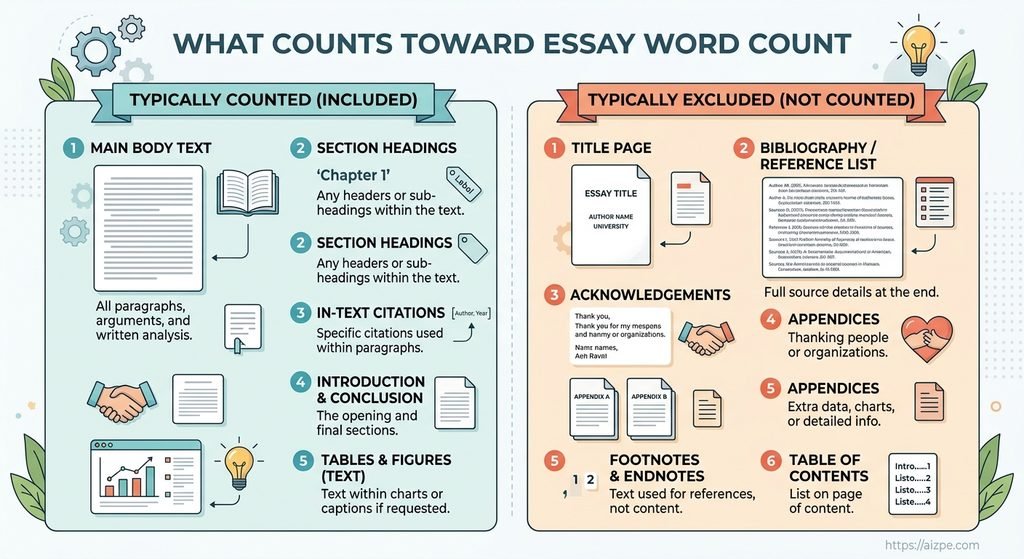
What Counts Toward Essay Word Count
There is no single, universal rule. The safest approach is to ask your instructor or check the assignment instruction sheet. In the meantime, here are some points that often cause confusion.
Title, headings and citations
Many instructors only count the body of the text, excluding the title, headings, and list of references. Others, however, count everything. In-text citations, such as (Smith, 2020), are usually counted as part of the body, whereas the bibliography generally is not. Check the instructions.
Footnotes, bibliography and quotes
Microsoft Word‘s word count tool has an option to include or exclude text boxes, footnotes and endnotes. If your teacher says footnotes don’t count, switch that option off. Long block quotes usually do count toward your total, so you can’t easily use them to reach the target.
Hyphenated words and numbers
Most tools count a hyphenated word, such as “well-known,” as a single word; the same applies to a number, such as “2026.” Some counters may treat an em dash used without spaces—for example, “and—but”—as a single word, which could slightly reduce the total count. If accuracy is important, add spaces around em dashes.
Typical Essay Lengths
These are rough guides. Your assignment sheet always comes first.
| Essay type | Common length |
| One paragraph | 100 to 200 words |
| Short essay | 500 words |
| Standard essay | 1,000 words |
| Five-paragraph essay | 500 to 800 words |
| Longer paper | 1,500 to 3,000 words |
A useful rule: some instructors accept about 10 percent above or below the target, but many don’t. Never assume. Ask.
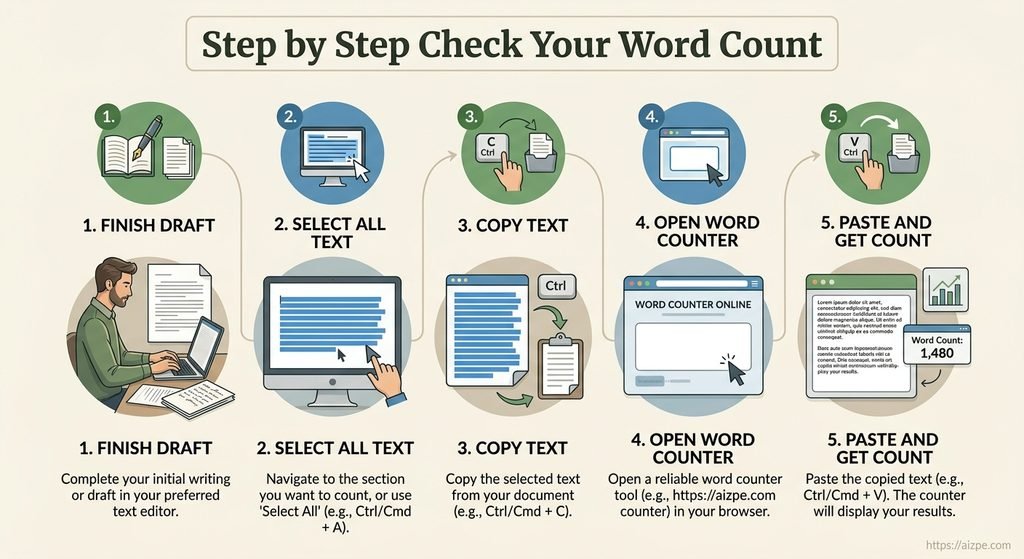
Step by Step: Check Your Word Count
- Finish your draft. Count the final version, not an early one.
- Copy only the part that counts. If the title and bibliography are excluded, copy just the body.
- Paste it into the word counter. Use our free Word Counter and read the total instantly.
- Compare with the limit. Check the number against the assignment.
- Recount after editing. Every cut or addition changes the total.
You can also check in your writing app. Word shows the count at the bottom of the window, and Google Docs shows it under Tools. Your online counter and your app may differ by a few words, because they treat symbols differently.
How to Cut Words Without Losing Meaning
If you’re over the limit, try this order:
- Remove repeated points. If two paragraphs say the same thing, merge them.
- Shorten your introduction. Skip the long background and get to your main point.
- Replace long phrases. ‘Due to the fact that’ becomes ‘because’. ‘In order to’ becomes ‘to’.
- Cut weak adverbs. Words like ‘very’, ‘really’ and ‘quite’ can usually go.
- Trim quotes. Quote only the part that matters.
How to Add Words Naturally
If you’re under the limit, don’t pad. Add something real instead:
- A specific example or short case study
- A counterargument and your answer to it
- A clearer explanation of a hard term
- A stronger link between your evidence and your main point
Raising your word count with filler makes the essay weaker, and teachers notice.
Word Limits in Common Situations
Different tasks use very different rules. Here are the ones students ask about most.
- College application essays: many fall between 250 and 650 words. The Common App main essay has a 650 word maximum. Follow the application’s rule exactly.
- IELTS Writing: Task 1 asks for at least 150 words and Task 2 for at least 250 words. Writing under the minimum can lower your score, so check your count in practice.
- University coursework: often a target with a margin of about 10 percent, but only if your instructor says so.
- Scholarship essays: often strict. Going over can mean the extra text is cut off or ignored.
If you’re not sure, read the instructions again and ask. It’s a quick email, and it can save a grade.
A Simple Plan for Hitting 1,000 Words
The easiest way to hit a count is to give each part its own budget.
| Part | Words |
| Introduction with your main point | 100 |
| Body paragraph 1 | 250 |
| Body paragraph 2 | 250 |
| Body paragraph 3 | 250 |
| Conclusion | 100 |
| Buffer for edits | 50 |
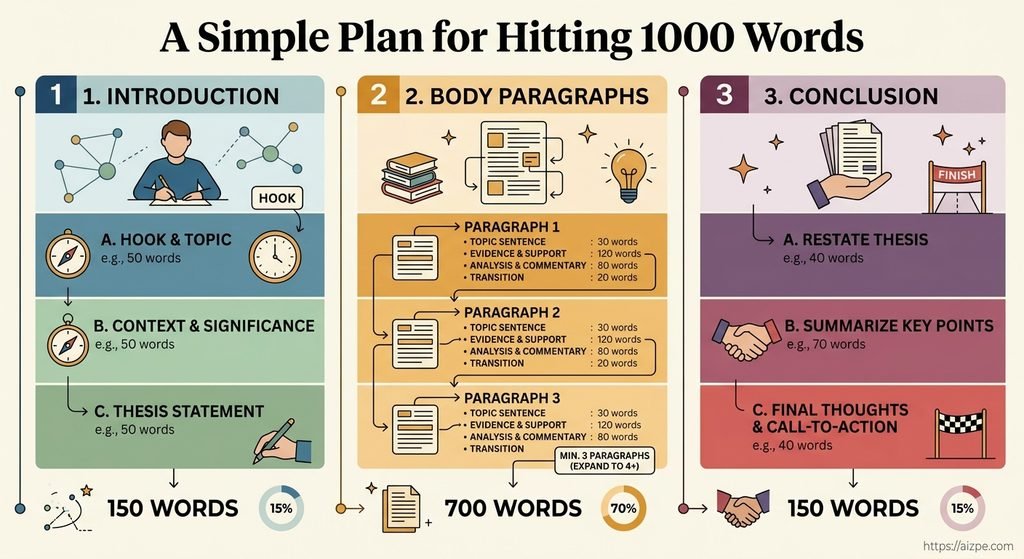
For a 500-word essay, halve the body paragraphs (about 100 to 120 words each). For 1,500 words, add a fourth and fifth body section, or give each one more depth.
A Worked Example
Your assignment says 1,000 words, not including the reference list.
- You paste the whole document into the counter and see 1,180 words.
- You realise that includes about 130 words of references. You paste only the body and get 1,047.
- You’re 47 words over. You cut a repeated sentence in the introduction (25 words) and trim filler phrases in two paragraphs (22 words).
- You paste again and see 1,000.
The whole check took a few minutes, and you didn’t lose a single idea.
Counting Tips for Academic Writing
- Abstracts, tables and figure captions vary. Ask.
- Numbers and abbreviations count as one word each.
Common Mistakes
- Counting an early draft and forgetting to recount.
- Including the reference list when it should be excluded, or the other way around.
- Going over because ‘the tool said so’. Different tools differ by a few words, so leave a small margin.
- Padding with filler. Phrases like ‘it is important to note that’ add words and take away clarity.
- Ignoring the rule when it matters. A strict limit means strict.
FAQs
Do references count in an essay word count?
Usually no, but it depends on your teacher. Always check the instructions.
Is the word count different in Word and Google Docs?
Sometimes by a few words, because they handle symbols, dashes and numbers a little differently. If it matters, use the same tool your teacher uses.
Can I go over the word limit?
Only if your teacher allows it. Some allow about 10 percent, but others penalise any excess. Ask first.
How long does it take to write a 1,000-word essay?
That depends on your research and preparation. Planning an outline first usually makes drafting faster.
Does the abstract count toward the word limit?
It depends on the instructions. For many journals the abstract has its own limit. For coursework, ask your instructor.
Do in-text citations count?
Usually yes, because they’re part of the body text. The reference list is usually separate.
How many words should a paragraph have?
About 100 to 200 words for academic writing. Shorter paragraphs work better online.
Final Thoughts
A good essay word count is accurate, matches your teacher’s rules and leaves no filler. Count the right part of your text, check it against the limit, and edit with purpose. For a quick, accurate total, paste your essay into our free Word Counter.
Related reading: How Many Pages Is 1000 Words | How to Count Words in Google Docs, Word and PDF